
Every article here is original, cites its sources, and connects back to what actually happens when a rural classroom gets a live link to the world — the same Global Classroom model our founder has run for over a decade.
How a laptop, a speaker, and one internet connection became a repeatable model for connecting rural classrooms to the world — and why it may be the clearest blueprint yet for educational transformation at scale.
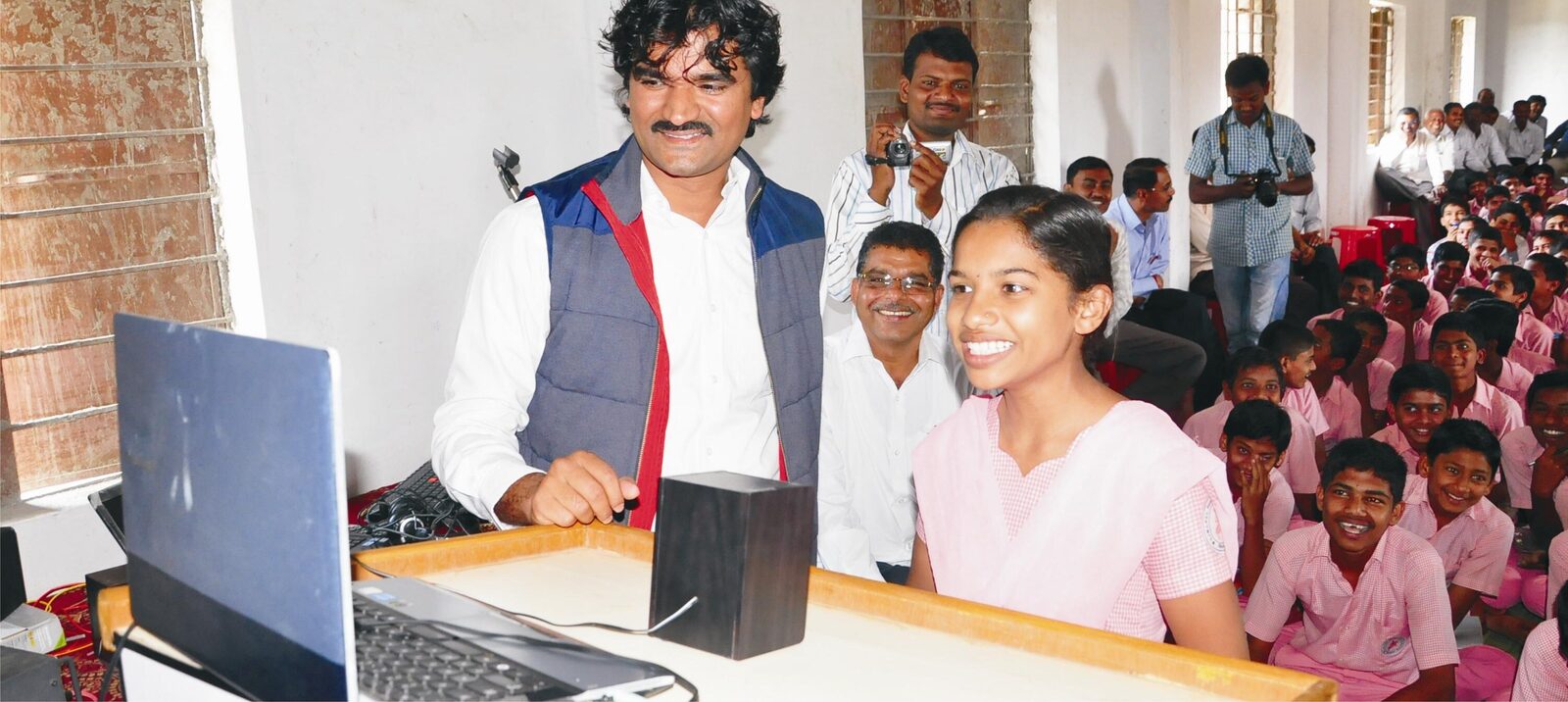
In 2013, Santosh Talaghatti started with a simple question: what does a village school actually need to give its students the same exposure a city student takes for granted? Not a computer lab. Not an app. Just a live connection to someone who could answer a real question. That question became the Global Classroom model, run through eLMNOP in Maharashtra, India — and over a decade later, it has reached more than a thousand schools and connected students to experts across 15 countries.
What makes the model transferable isn't the technology — it's the sequence. A school is identified. The community, not just the classroom, is brought on board, because a Global Classroom only survives if parents and local leaders believe in it. Hardware and connectivity, minimal as they are, are secured through partnerships rather than school budgets. Teachers are trained first, so the technology never becomes the thing they're afraid of. Only then does the live session happen.
Global Classrooms Foundation exists to test whether that same sequence works outside India — not by inventing something new, but by extending a model that has already survived a decade of real classrooms, real villages, and real constraints. In a field full of platforms promising to "disrupt" education, there's something to be said for a model that has simply kept working.
Nearly a third of the world's students still can't access remote learning. Here's what the data says about who's being left out of the education technology revolution — and why that's exactly who Global Classrooms is built for.
It's easy to talk about the "EdTech revolution" as if it's already arrived everywhere. It hasn't. UNESCO estimates that at least 463 million students worldwide — nearly one in three — cannot access remote learning, mostly because of missing policy, missing equipment, or both. Globally, 60% of primary schools, half of lower-secondary schools, and a third of upper-secondary schools are still not connected to the internet at all.
The gap is steepest exactly where the need is greatest. In sub-Saharan Africa, 89% of learners lack access to a household computer and 82% lack internet access. Worldwide, 2.6 billion people — 32% of the planet — still lack internet access, and 1.8 billion of them live in rural areas. Gender compounds the gap further: in parts of Africa, Asia, and South America, women are 30–50% less likely than men to use the internet at all.
These aren't abstract statistics to a program like Global Classrooms. They describe exactly the schools the model was built for — the ones a lab full of computers would never reach, because a lab full of computers assumes infrastructure that doesn't exist yet. The response isn't to wait for full connectivity; it's to build a program lightweight enough to work with what's already there, and generous enough that global experts, not expensive hardware, do the heavy lifting.
Sources: UNESCO (Digital Divide in Distance Learning, 2024–2025); World Bank digital inclusion research.
AI adoption in education has moved faster than almost anyone predicted. The harder question is whether it's reaching the students who need it most — or just the ones who already had the most.
The numbers on AI in education are startling for how fast they moved. Recent research puts global student AI use at 86%, with roughly a quarter of students using it daily. Teachers report real instructional impact: 59% say AI has enabled more personalized instruction, and studies suggest personalized approaches can improve student outcomes by as much as 30%. The global AI-in-education market, valued at roughly $7 billion in 2025, is projected to grow nearly twentyfold within a decade.
But adoption isn't evenly spread. K–12 schools account for the majority of AI deployments, yet 43% of school districts cite inadequate teacher training as their biggest barrier — and in many rural schools, unreliable connectivity rules out cloud-based AI tools before training is even a question. The same divide that shapes basic internet access shapes who gets to benefit from personalization at all.
For a program like Global Classrooms, AI is a tool worth watching closely, not adopting for its own sake. A personalized learning algorithm is only as useful as the connectivity and teacher confidence underneath it — which is exactly why the model still leads with a human being on a video call, not a chatbot, as the first point of contact between a student and expertise from beyond their village.
Sources: Demandsage & Enrollify AI-in-Education research summaries, 2026; global EdTech market analyses (Grand View Research, Fortune Business Insights).
Not every learning revolution needs a smartphone. In much of the world, it's the basic feature phone — not the laptop — that's actually closing the gap.
In East Asia, the Pacific, and Europe, roughly 80% of adults own smartphones. In sub-Saharan Africa, that figure drops to about 33%; in South Asia, 40%. And yet 84% of adults in developing economies own some kind of mobile phone — meaning the real story of mobile learning in the Global South isn't about smartphones at all. It's about what's possible on a basic device.
According to GSMA research, roughly 75% of low-income countries' mobile users access educational content via feature phones — devices with no internet connection, often just SMS and voice. UNESCO reports that 65% of primary schools in low-income countries have some access to mobile devices for education, even where broadband infrastructure lags. And the impact is measurable: RAND Corporation research found mobile learning tools improved student test scores by roughly 12% compared to traditional methods alone.
This is the quiet counterpoint to every headline about laptops-per-child programs: the device that actually reaches a rural village is often the one already in someone's pocket. It's a lesson the Global Classroom model has leaned into from the start — a single laptop and speaker, shared by a whole classroom, has always mattered more than one device per student.
Sources: World Bank digital inclusion research; GSMA Mobile for Development reports; RAND Corporation mobile learning studies.
Every education technology story eventually runs into the same bottleneck: a confident teacher, or the lack of one. Here's why that's still the real variable.
It's tempting to think of education technology as a hardware and connectivity problem. It's just as often a confidence problem. UNESCO's 2025 SDG 4 progress report found that of all the targets countries are falling short on, teacher training is among the furthest off track — roughly 7 percentage points behind national benchmarks in pre-primary education alone. A tool a teacher doesn't trust is a tool that sits unused, no matter how capable it is.
This is the reason the Global Classroom model puts teacher orientation before the first live session, not after. Every school that joins goes through the same sequence: teachers get hands-on with the technology, and confidence-building comes before the cameras turn on. It's slower than simply shipping hardware to a school — and it's the difference between a laptop that gathers dust and one that's still running sessions a decade later.
The lesson scales beyond any one program: the most sophisticated AI tutor or the fastest connection in the world still depends on a teacher willing to use it. Educational transformation, in the end, is a people problem wearing a technology costume.
Source: UNESCO Global Education Monitoring Report, 2025 SDG4 Scorecard.
Gamification has a reputation for being a gimmick. The meta-analyses tell a more interesting story.
A 2023 meta-analysis covering 41 studies and more than 5,000 participants found a significant, large effect size for gamification as a teaching and learning tool — not a marginal one. Challenge-based gamified instruction has been shown to improve student performance by as much as 89% compared to straight lecture-based teaching in some studies, with average performance gains across research settings landing around 35%.
The effect isn't automatic, though. Researchers consistently find that outcomes depend heavily on design: gamification works when it satisfies a learner's sense of autonomy, competence, and connection to others — through meaningful choice, immediate feedback, and a sense of shared progress — not just points and badges layered onto an otherwise unchanged lesson.
For the Global Classroom model, the "game" has always been simpler than a leaderboard: the immediate, visible feedback loop of a real person, on the other end of a video call, responding to a student's own question. It turns out that's a form of gamification too — just one that predates the term.
Source: Frontiers in Psychology, "Examining the effectiveness of gamification as a tool promoting teaching and learning in educational settings: a meta-analysis" (2023).
The UN's goal of quality education for all was supposed to be within reach by 2030. The latest scorecard says otherwise — and explains exactly where the effort needs to go.
The UN's Sustainable Development Goal 4 — quality education for all, by 2030 — is, by the UN's own admission, off track. The global out-of-school population has actually grown by 3% since 2015, leaving 272 million children and youth without schooling. Learning outcomes tell a similarly sobering story: only 58% of students worldwide reached even the minimum proficiency level in reading by the end of primary school as of the most recent assessment.
There are bright spots: 90% of countries have now set national benchmarks aligned to SDG 4. But the furthest-behind targets — teacher training, early childhood education access, and reading proficiency — are precisely the areas where technology alone won't move the needle without the human infrastructure (trained teachers, engaged communities) to support it.
Global Classrooms Foundation doesn't claim to close this gap alone. But every program built on the same principles — connect a real expert to a real classroom, train the teacher first, prioritize the schools furthest behind — is a small, additive contribution toward a goal the world is currently missing.
Source: UNESCO Global Education Monitoring Report, 2025 SDG4 Scorecard; UN Sustainable Development Goals Report 2025.
EdTech isn't a 2020s invention. It's the latest chapter in a much longer story — and understanding that history explains why the market is now worth nearly $190 billion a year.
Every generation has had its own "education technology": the printed textbook, the radio lesson, the overhead projector, the classroom computer lab. What's different now is scale and speed. The global education technology market was valued at roughly $187 billion in 2025 and is projected to more than double, toward $437 billion, by 2033 — driven largely by demand for personalized, AI-assisted learning tools.
The pandemic-era shift to remote learning accelerated a decade of change into roughly eighteen months, normalizing video-based instruction, cloud classrooms, and asynchronous learning almost overnight. What it also exposed, starkly, was the digital divide underneath that acceleration — the same 463 million students without remote-learning access were the ones the "EdTech boom" moved past.
Seen against that longer arc, the Global Classroom model looks less like a startup idea and more like a return to something simpler that got lost along the way: technology used specifically to put a student in front of a real expert, rather than in front of more content. The tools have changed. The goal hasn't.
Source: Grand View Research & Fortune Business Insights, Education Technology Market reports, 2025–2026.
Global Classrooms Foundation isn't the only organization betting on live, cross-border classroom connections. Here's how the wider virtual exchange movement is reshaping what "studying abroad" means.
Long before video calls were routine, educators were experimenting with ways to connect classrooms across borders without the cost of travel. Today that idea has a name — virtual exchange, or Collaborative Online International Learning (COIL) — and a growing track record. Research on virtual exchange programs consistently finds gains in critical thinking, cross-cultural communication, and what's often called "global competency": the ability to work effectively with people from different backgrounds and countries.
The movement has real institutional weight behind it. Global Classrooms, a program of the United Nations Association of the USA, has run Model UN-based virtual and in-person exchange for middle and high schoolers since 1999. Skype in the Classroom and the British Council's Connecting Classrooms program have each linked thousands of classrooms across continents for live, curriculum-based exchanges. Universities increasingly treat COIL partnerships as a low-cost substitute for study-abroad access.
The Global Classroom model our founder built through eLMNOP shares the same DNA, applied to a different gap: instead of connecting two classrooms of similar means, it connects a classroom with limited resources directly to individual experts and mentors abroad. Different entry point, same underlying bet — that a live conversation across a border changes a student more than a textbook chapter about that border ever could.
Sources: AAC&U Virtual Exchange/COIL research summaries; EDUCAUSE Review, "Collaborative Learning in Global Online Education" (2017); UNA-USA Global Classrooms program history.
The education technology revolution doesn't reach everyone equally. Gender and geography still shape who gets to benefit — and why "connect the classroom" isn't the same as "connect every student."
Behind the aggregate statistics on global connectivity sit sharper inequities. UNESCO research across ten countries in Africa, Asia, and South America found women are 30–50% less likely than men to use the internet at all, and globally, women are 23% less likely than men to use mobile internet specifically. In regions with the lowest smartphone access, that gender gap widens further, compounding disadvantages that already exist around income and geography.
Geography compounds it again: 1.8 billion of the 2.6 billion people worldwide without internet access live in rural areas, precisely the communities furthest from the physical infrastructure — fiber lines, cell towers, reliable electricity — that urban EdTech adoption takes for granted.
This is why "connecting classrooms" has to mean something more specific than installing routers. Programs built around the Global Classroom model prioritize community buy-in explicitly because getting a family, not just a school, to trust and use new technology is often the harder half of the problem — and it's disproportionately girls and rural students who are left out when that step gets skipped.
Sources: UNESCO gender and digital inclusion research; World Bank rural connectivity data.